

Chandan
The Smuggler's Highball
A long aromatic serve that lets sandalwood, citrus, and oak lead.
Adults only
Lootera is an alcoholic drink and this site is for adults. Please confirm your age to enter.
By entering you agree to our Terms and Privacy Notice. Please drink responsibly.

The Mattancherry Chronicles · Chapter 01
Lootera Sandalwood Gin — The Smuggler
Chandan is the first Lootera gin: a small-batch sandalwood gin with citrus peel, black pepper, spice and polished juniper, finished in ex-Cognac French oak. Warm, woody and aromatic — made for martinis, Negronis and slower evening serves.
Sandalwood gin · 700 ml · 40% vol. · Small batch spirit
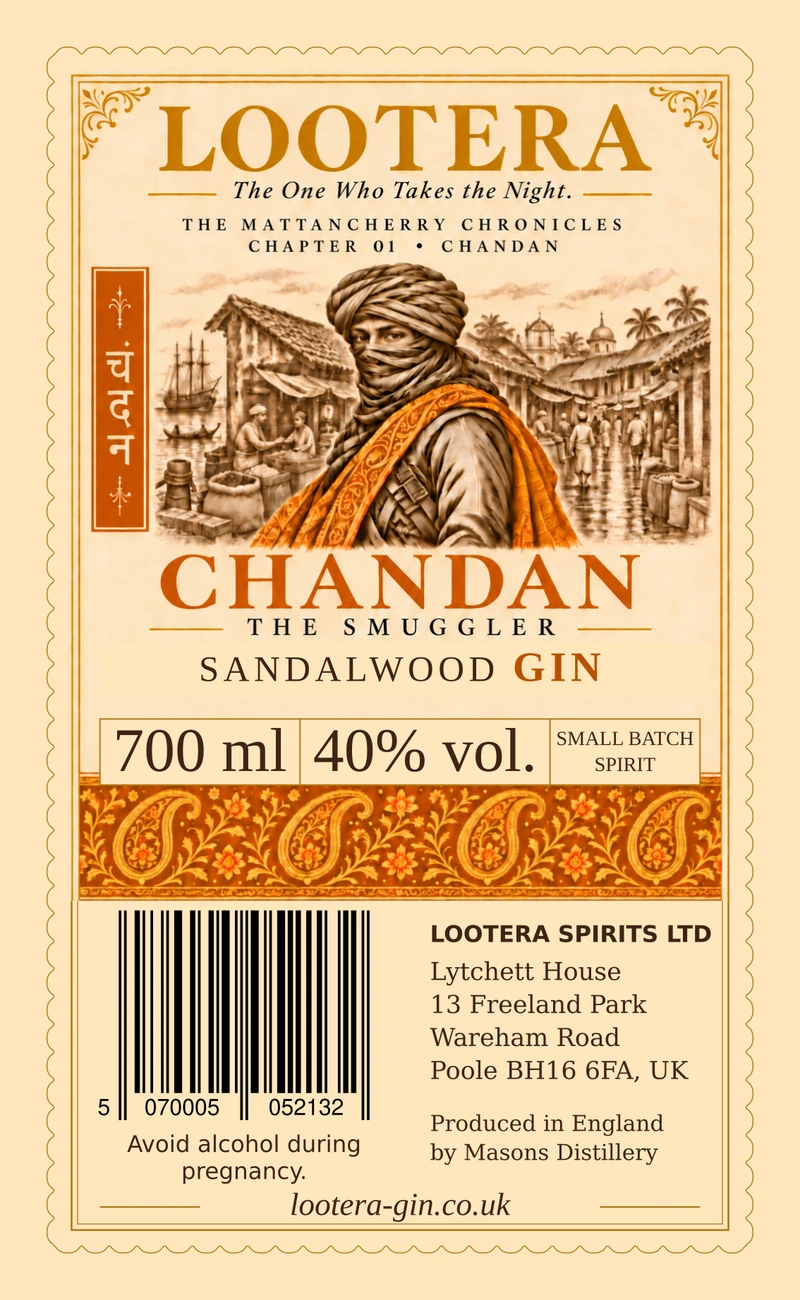
Sandalwood gin · 700 ml · 40% vol. · Small batch spirit
Sandalwood gin. Chapter 01 of the Mattancherry Chronicles.
Sandalwood gin
Warm, woody, aromatic and layered. Built for martinis, Negronis and slower evening serves.
Sandalwood, citrus peel, black pepper, spice and polished juniper, finished in ex-Cognac French oak for depth, texture and a lingering amber finish.
Serve it Smuggler's Highball · Sandalwood Old Fashioned · Negroni · Martini
The character behind Chandan.

Chapter 01 · The Mattancherry Chronicles
His face is shrouded; the story arrives before the face.
The Smuggler moves sandalwood, spice and stories through the old harbour markets. Chandan is his gin: warm, woody and aromatic, with citrus peel, black pepper and ex-Cognac oak for depth.
Simple enough for service. Distinctive enough to become a signature.
Chandan
A long aromatic serve that lets sandalwood, citrus, and oak lead.
Chandan
A bridge for whisky drinkers: Chandan, demerara and bitters over one large cube.
Lootera grew out of the flavour work behind LXV Wine and its spice pairings. LXV uses spices and ingredients to change how a wine is experienced; Lootera moves that principle from wine pairing into cocktail culture by placing one central Indian ingredient at the heart of each expression. The ingredient shapes the liquid, and the liquid determines how the gin is used.
Chandan opens the story. Two more gins are coming next.
Lootera is a range of gins built around Indian ingredients. Chandan, the first, is a sandalwood gin at 40% vol., sold in 700 ml bottles and produced in England by Masons Distillery. It is finished in ex-Cognac French oak. Neel and Namak are the next two gins in the range.
Chapter 01 · Sandalwood gin
Warm, woody, and sandalwood-led. Built for martinis, Negronis, and slower evening serves.
Sandalwood, citrus peel, black pepper, spice, polished juniper, and ex-Cognac French oak for depth, texture, and a lingering amber finish.
Trade roleThe darker, more contemplative anchor.

Coming next · Indigo botanical gin
Floral, vivid, and indigo-led. Built for colour-changing cocktails, sours, and signature serves.
Butterfly pea flower, hibiscus, rose petal, cardamom, spice, and juniper for lifted florals, vivid aromatics, and colour-changing cocktail theatre.
Trade roleThe visually expressive theatre and press hook.

Coming next · Coastal Indian gin
Crisp, mineral, and sendha namak-led. Built for G&Ts, highballs, aperitifs, and food pairing.
Kokum, curry leaf, coriander seed, dried lime, black salt, and sea-air freshness for savoury-mineral lift, G&Ts, highballs, and food-pairing moments.
Trade roleThe fresh, versatile, table-oriented volume driver.
The characters who carry the world.
The Looterās are charming rule-breakers who move between worlds carrying flavour, scent, colour, and story.

Chandan
Sandalwood. Warm, woody, aromatic, layered.
Warm, woody, aromatic and layered.
Sandalwood, citrus peel, black pepper, spice, polished juniper, and ex-Cognac French oak for depth, texture, and a lingering amber finish.
The premium anchor.

Neel
Indigo botanicals. Floral, vivid, bright, transformative.
Bright, floral, transforming.
Butterfly pea flower, hibiscus, rose petal, cardamom, spice, and juniper for lifted florals, vivid aromatics, and colour-changing cocktail theatre.
The theatre and press hook.

Namak
Sendha namak. Crisp, mineral, saline, food-friendly.
Crisp, mineral, food-friendly.
Kokum, curry leaf, coriander seed, dried lime, black salt, and sea-air freshness for savoury-mineral lift, G&Ts, highballs, and food-pairing moments.
The approachable volume driver.
A premium range built for confident placement.
The UK gin category is contracting, so Lootera cannot rely on category growth. It has to take share with a specific proposition: a premium, cocktail-led gin built around Indian ingredients and introduced through accounts capable of explaining and serving it well. Lootera's advantage is not one feature — it is the connection between the liquid, the serve, the bottle, and the next purchase.
01
An unmistakable label language that stands out in premium gin.
Three immediately related bottles with distinct colour coding and character-led labels.
A name, a character, a flavour cue — and one line worth repeating: Choose your accomplice.
Place the range together where possible and support it with concise story cards.
02
Every bottle comes with a character, a script, and a trade story.
British gin structure, Indian flavour imagination, and three characters with distinct liquid roles.
Lead with character, then flavour, then serve.
Each expression receives a one-line script, one signature serve, and one guest recommendation.
03
Back bars, gifting, premium retail, and modern Indian dining.
Cocktail bars, hotel bars, private members clubs, and premium restaurants.
Design-led bottle shops, premium gifting, and three-bottle discovery sets.
Founder-led tastings, dinners, cultural events, and private hosting.
04
Three expressions that invite discovery and repeat purchase.
Three expressions with distinct flavour and visual roles encourage exploration.
Single-bottle discovery can lead into a three-bottle set.
Character cards, cocktail cards, and seasonal serves create reasons to return.
05
Three Indian ingredients tied to three cocktail applications, a character-led postage-stamp pack, and a campaign built into every bottle — operating as one system.
Stranger & Sons, Hapusa, Jaisalmer, and Jin Jiji already hold UK specialist-retail attention for Indian-provenance gin, typically priced from the upper £30s to low £40s.
Distilled in Goa with Indian citrus, pepper, and coriander — strong modern Indian storytelling and bartender credibility.
Competes on Himalayan juniper and ingredient provenance — authenticity and serious premium positioning.
Competes on luxury presentation, gifting, and broad consumer accessibility.
Competes on Indian botanical storytelling and range depth across multiple expressions.
A contracting category — which is exactly why positioning has to do the work.
The United Kingdom remains one of the world's most established gin markets, but it is no longer a category in which general growth will carry a new entrant.
01
Flavoured gin has fallen to roughly half its 2020 peak, and crowded shelves have led to listing rationalisation.
UK gin volumes fell by 14% in 2023. Premium-plus gin volumes declined by 16%, and IWSR forecast an average annual decline of 5% for that tier between 2023 and 2028. Flavoured-gin sales have fallen to approximately half their 2020 peak and are declining more than twice as quickly as traditional gin. Crowded shelves and back bars have consequently led to listing rationalisation.
Total UK beverage-alcohol volumes declined by 2% between 2022 and 2023, while spirits declined by 5%. Moderation, reduced discretionary spending, and competition from other spirits categories are reshaping consumer demand.
02
426 distilleries and over £500 million of exports in 2024 — the infrastructure and credibility are intact.
The category is contracting, but the UK remains a major gin-producing and exporting centre. In 2024 it had 426 registered distilleries and exported the equivalent of more than 185 million bottles of gin, worth over £500 million.
03
Begin with cocktails, give each expression a clear use, launch through informed accounts, connect one expression to the next, and concentrate the launch.
Who Lootera is measured against, and the position it intends to own.
Modern Indian storytelling and bartender credibility, distilled in Goa.
Strong contemporary Indian identity and cocktail-bar relevance. Distilled in Goa using Indian citrus, pepper, coriander and other botanicals. Its strength lies in modern Indian storytelling and bartender credibility.
Ingredient provenance and serious premium positioning, led by Himalayan juniper.
Competes through ingredient provenance and serious premium positioning, particularly its association with Himalayan juniper and Indian botanicals. Its strength is authenticity and ingredient-led credibility.
Recognisable luxury, gifting cues and broad consumer accessibility.
Competes through luxury presentation, Indian provenance, gifting and established premium cues. Its strength is recognisable luxury and broad consumer accessibility.
Range depth and Indian botanical variety across multiple expressions.
Competes through Indian botanical storytelling and multiple expressions. Its strength is range depth and ingredient variety.
Premium martini gins, design-led giftable gins, colour-changing gins, and high-end botanical spirits.
Master of Malt's current Indian-gin selection includes Jaisalmer, Jin Jiji, Stranger & Sons and Hapusa — confirming these brands already compete for UK specialist-retail attention. Listed prices place the core expressions broadly between the upper £30s and low £40s.
A three-expression British-distilled gin range in which ingredients, cocktail use, packaging and an ongoing bottle campaign operate as one system.
A three-expression British-distilled gin range in which Indian ingredients, cocktail use, packaging and an ongoing bottle campaign operate as one system.
Its advantage is not one individual feature. It is the connection between the liquid, the serve, the bottle, and the next purchase.
Lootera must first convince the buyers and gatekeepers who decide where it is poured and sold — accounts that can introduce an unfamiliar ingredient and present the range at the intended premium level.
Accounts where Indian flavour intelligence already has value.
Indian flavour intelligence already has value here — staff and guests already have the vocabulary for sandalwood, indigo botanicals, and sendha namak.
Menu-paired serves, tableside storytelling, and a natural home for launch dinners.
Accounts that need theatre, story, and distinctive serves.
These rooms need theatre, story, and a distinctive serve — Neel's colour change and Chandan's oak story both give bartenders something to perform, not just pour.
Signature serves, bartender training, and back-bar story cards.
Accounts that respond to wit, status, international appeal, and insider discovery.
These rooms respond to wit, status, international appeal, and insider discovery — exactly what the Looterā characters and the job system are built to deliver.
Founder-led tastings, prestige placement for Chandan, and gifting sets for members.
Accounts that can hand-sell story, packaging, and gifting.
Staff who can hand-sell story, packaging, and gifting turn browsers into three-bottle-set buyers.
A dedicated display, staff tasting and education, and removable job tags on every bottle.
Consumers who value cultural confidence, design, and premium entertaining.
Premium hosts and tastemakers seeking cultural confidence without cliché.
Particularly relevant to gifting, private entertaining, early word of mouth, and cultural credibility.
They'll order a Neel before they'd ever buy a bottle of gin. The drink has to earn the purchase first.
Choose an accomplice. Enter their world. Discover the next one.
The campaign turns three expressions into a connected system of discovery. The bottle creates the first question; the character creates affinity; the QR-led assignment gives the consumer a reason to continue. The permanent label carries the identity and the character. The removable neck tag and QR code carry the changing campaign — so the jobs can evolve without altering the approved label designs.
Front: Your next job is inside. Scan to begin. Back: every Lootera bottle unlocks a new assignment, a new way to drink it, and a clue to what comes next. Scan. Pour. Complete the job.
YOUR NEXT JOB IS INSIDE. Scan to begin.
Every Lootera bottle unlocks: a new assignment, a new way to drink it, and a clue to what comes next. Scan. Pour. Complete the job.
The Midnight Table. Your Lootera: Namak. Serve it with one savoury bite, don't reveal the pairing, and ask the table to describe the final flavour in one word.
Namak
Serve Namak with one savoury bite. Do not reveal the pairing. Ask everyone at the table to describe the final flavour in one word.
Share your three words to unlock the next assignment.
No great heist is a solo job. Progress is built from trying every expression and completing assignments, not generic points.
Secret cocktail recipes, off-menu drinks at participating venues, private tastings, early access to releases, and limited physical collectibles.
Simple enough to understand in a bar. Rich enough to continue after purchase.
The journey has to be measurable enough to show whether the launch is building a multi-expression brand rather than three isolated products.
A portrait, a partner, a serve or a bottle.
Select an accomplice.
Scan, unlock, taste or attend.
Meet another expression.
Reorder, collect, gift or share.
Trial by expression and account, QR participation, cross-expression movement, reorder velocity, and three-bottle collection behaviour.
The key measure is not awareness alone. It is whether one accomplice creates curiosity about another.
A story a rep can sell in seconds.
20 secondsLootera is a British-distilled gin range built around three Indian ingredients: sandalwood, indigo, and sendha namak. Chandan is warm and woody, built for martinis and slower evening serves. Neel is floral and colour-changing, built for sours and signature drinks. Namak is crisp and mineral, built for G&Ts, highballs, and food pairing. Choose your accomplice.
5 secondsBritish gin structure. Indian flavour imagination. Choose your accomplice.
The UK launch is not a conventional product launch. It is a staged reveal: London meets the accomplices before it meets the bottles.
01
UK gin volumes fell 14% in 2023, premium-plus gin fell 16%, and IWSR forecasts a further ~5% annual decline through 2028. Category growth will not carry a new entrant here — distinct positioning has to.
UK gin volumes fell 14% in 2023; premium-plus gin volumes fell 16%, with IWSR forecasting a further ~5% average annual decline between 2023 and 2028. Flavoured-gin sales have fallen to roughly half their 2020 peak, declining more than twice as fast as traditional gin. Total UK beverage-alcohol volumes fell 2% and spirits fell 5% between 2022 and 2023. Source: IWSR (theiwsr.com).
The UK remains a major gin-producing and exporting centre: 426 registered distilleries in 2024, exporting the equivalent of more than 185 million bottles of gin worth over £500 million. Source: WSTA (wsta.co.uk).
Start with design-led premium accounts where story and cultural fluency create value.
Seed respected accounts, create visible serves, activate founders, and convert attention into repeat listings.
02
British gin structure, Indian flavour imagination — three connected expressions instead of one flavoured novelty.
A recognisable gin ritual and premium back-bar language.
Botanicals, character, colour, salt, appetite, and cultural confidence.
03
London's hospitality and experience economy is investing almost £10 billion over ten years, with roughly 50 new hotels opening in 2025 alongside an existing base of about 1,900 (London & Partners) — the right market to prove the range in a small number of credible rooms.
London & Partners reports almost £10 billion of investment expected in the city's experience economy over ten years, with about 50 new hotels opening in 2025 in addition to an existing base of roughly 1,900. Source: London & Partners (londonandpartners.com).
Distinctive serves and strong visual presence.
Collectability, gifting, and hand-sellable stories.
Food pairing, private hosting, and premium cultural experiences.
04
Curiosity in Weeks 1–2, the reveal in Weeks 3–4, discovery in Weeks 5–6, deeper connection in Weeks 7–8 — with Dishoom, Amathus and Master of Malt each playing a distinct role in the same story.
Seed the three portraits across selected London touchpoints without bottles or full explanation. Use names, questions and visual repetition to make the audience ask who these people are.
Reveal that the portraits belong to Lootera. Introduce each accomplice through a small number of credible partners, with staff trained to connect character, ingredient and serve.
Invite consumers to choose an accomplice and unlock the world behind that expression: stories, rituals, signature serves and introductions to the other two.
Use recommendations, invitations, limited drops and collection mechanics to move the consumer from one Lootera expression to another.
Beyond the bottle: the three characters give Lootera an expandable world across hospitality, retail, digital, events and future products — so every activation adds to the same intellectual property rather than becoming a one-off campaign.
Trade activation, account education, and founder energy.
Direct storytelling and liquid education for priority accounts.
A guided range tasting built around character, flavour, serve, and account fit.
35–45 minutes.
Three bottles, tasting mats, character cards, cocktail cards, and an account follow-up sheet.
Simple rep, bartender, and server materials.
Placement logic, account fit, commercial role, and objections.
Liquid story, signature serves, and substitution guidance.
One sentence per expression and one guest recommendation.
Recommended serves for each expression.
Highball and Old Fashioned-adjacent serves.
Colour-changing, sparkling, and event-friendly serves.
Gimlet, highball, and food-pairing serves.
Fast guest-facing language for tableside selling.
Character image, expression name, and one-line flavour hook.
20-second staff script, signature serve, and guest recommendation.
Premium Indian restaurants, hotel bars, members clubs, and private cultural tastings.
Three courses, three expressions, and one simple signature serve per course.
Three-character cocktail menu with a brief founder introduction.
A design, flavour, and storytelling-led format for premium hosts and members clubs.
Three-bottle sets, character cards, cocktail cards, and a founder note.
The complete cast presented as a collectible range.
Character cards, cocktail cards, founder note, and tasting order.
Corporate gifting, premium hosting, festive retail, and account seeding.
Visual storytelling, cocktail theatre, founder story, and character-led launch content.
The Looterās, cocktail transformation, botanicals, founder story, and London launch.
Neel colour change, Chandan oak story, and Namak food pairing.
Co-created launch posts, bartender serves, menu features, and event recaps.
Prove the system before pursuing distribution.
The first year is a controlled test of three things at once: the liquid, the characters, and the journey between expressions.
01
A concentrated London footprint tests on-trade discovery, specialist retail and online conversion without fragmenting the story.
Start with a deliberately concentrated London footprint. Dishoom, Amathus and Master of Malt are not simply sales outlets; together they let Lootera test on-trade discovery, specialist retail and online conversion without fragmenting the story.
Test whether trained staff can introduce an unfamiliar ingredient and character quickly enough to generate trial, repeat orders and conversation.
Test gifting, shelf presence, staff recommendation and whether the QR-led experience converts an object of curiosity into a purchase.
Track scans, story engagement, bundles and cross-expression purchase so the digital layer proves its commercial purpose.
02
Understand the role each expression plays: the strongest first cocktail, the strongest gift, the strongest route into food-led hospitality.
The objective is not to make every expression perform identically. It is to understand the role each one plays. One may be the strongest first cocktail, another the strongest gift, another the strongest route into food-led hospitality. Those differences should shape the next wave of distribution.
03
Expand only where the same launch mechanics can be repeated with discipline. New accounts enter as chapters, not listings.
Year Two should expand only where the same launch mechanics can be repeated with discipline. New accounts should enter as chapters in the existing Lootera world — with their own serves, assignments or moments of discovery — rather than as disconnected listings.
Add distribution when an account can do at least one of three things exceptionally well: introduce an accomplice, create participation, or move a consumer to another expression.
Scale principle: prove density before breadth. A small number of rooms where Lootera feels alive is more valuable than a large number of shelves where it is merely present.
For trade partners — the economics that have to hold for this strategy to work.
Lootera asks partners to sell a premium liquid, explain unfamiliar ingredients, activate three characters and participate in an ongoing campaign. The economics must leave enough value in the system for each of those jobs to be done properly. Detail is behind each reveal.
Premium signalling without pushing past the point of first-cocktail or gift discovery.
Recommended retail and on-trade pricing should signal premium positioning without pushing Lootera beyond the point where consumers will comfortably discover it through a first cocktail or gift purchase. The three expressions should sit together as a coherent family unless production economics create a defensible reason for differentiation.
Distributor, retailer and on-trade margins, with contribution preserved for activation and education.
Wholesale pricing must accommodate distributor, retailer and on-trade margins while preserving sufficient contribution for launch activation, sampling, campaign technology and partner education. A margin model that only works without activation would undermine the route-to-market strategy.
Production, packaging, landed cost, minimum runs, terms, reorder cadence, and campaign technology.
What a successful account looks like financially — a repeatable model established before expansion.
The pilot should establish what a successful account looks like financially: opening order, rate of sale, gross margin, activation effort, staff-training requirement and reorder timing. This creates a repeatable account model before expansion.
A full financial model built once prices, costs, margins and launch investment are confirmed — and used to set the pace of expansion.
A full financial model should be built once the wholesale price, recommended retail price, production costs, channel margins and launch investment are confirmed. Those figures should determine the pace of expansion — not be reverse-engineered to justify a predetermined rollout.
The commercial question is not simply, “Can we make the bottle at the right margin?” It is, “Can the entire Lootera experience be delivered profitably and repeatedly?”
Lootera is not built to win by adding another premium gin to a crowded category. It is built to make three bottles behave like one expanding brand world: the liquid gives it credibility, the packaging gives it recognition, the launch gives it momentum, and the customer journey gives it commercial purpose — each expression is designed to introduce the next.
Choose your accomplice.
A sandalwood gin from the Lootera range, 40% vol. in a 700 ml bottle. It is made with sandalwood, citrus peel, black pepper and juniper, and finished in ex-Cognac French oak.
Lootera Spirits Ltd owns the brand. Chandan is produced in England by Masons Distillery.
40% vol.
Detail depth
01
Method
Build over clear ice, top with soda, and express orange peel.
Service logic
Fast, aromatic, and low-complexity.
02
Method
Stir with ice and strain over a large cube.
Service logic
A bridge for whisky drinkers.
Detail depth
01
Method
Serve the lemon component separately and pour tableside to trigger the colour change.
Service logic
High-impact theatre with a simple build.
02
Method
Shake the first three ingredients, strain into a flute, and top with sparkling wine.
Service logic
Press-friendly and event-ready.
Detail depth
01
Method
Shake with ice and fine strain into a chilled coupe.
Service logic
Sharp, fast, and food-friendly.
02
Method
Build over ice and garnish with dried lime.
Service logic
A repeatable volume serve.
Trade depth
All commercial values remain placeholders until confirmed.